How to Write Content for Product-Led Growth
Somewhere right now, a stranger is deciding whether to keep your product.
Except if you’re product-led, there’s no sales to coax them into ✨trying that amazing feature that will change their life✨, no discovery call or demo to walk them through it.
It's just them, a screen, and whatever words you left there.
When the product does the selling, content becomes part of the product. And that changes what every word needs to achieve: from the blog post that pulls someone in, to the empty screen they land on, to the sentence that asks them to start paying.
Here's how to write killer content for product-led growth ⬇️
TLDR
Content for product-led growth helps the product sell itself. It lives inside the user journey, not around it.
Map content to five stages, not a funnel: acquisition, activation, retention, expansion, advocacy.
The in-product words – onboarding, empty states, errors – are the highest-leverage and most-ignored.
Write product-led content that only your product can answer, and write it in your customers' language.
Match the copy to your pricing model (trial, freemium or reverse trial) especially at the upgrade and downgrade moments.
Measure by activation and upgrades, not traffic. And with AI search sending fewer clicks, aim to be the answer that gets cited.
What is product-led growth content?
Content for product-led growth is content that helps the product do the selling.
Instead of feeding leads to a sales team, it guides people to feel the value themselves, spanning:
The blog posts that show your product solving a real problem
The in-product copy that gets a new user to their first win
And the words at the moment someone decides to pay.
In a product-led model, the product itself drives how you acquire, convert and keep customers. Think Figma, Notion, Calendly, Loom, Canva.
People sign up and use the product before anyone asks them to buy it. So content can't just talk about the product from a polite distance. It has to sit inside the journey and move people through it.
So content isn't wrapped around the product, it's woven into it.
How is PLG content different from normal content marketing?
Traditional content marketing hands the reader off to a sales team: a form gets filled, a lead gets scored, a human takes it from there.
Product-led content has no handoff. It passes the reader straight to the product, or it is the product. Which means it has to carry them further than content usually does: past interested and into actually using the product.
That changes everything downstream:
You're writing to a user, not a buyer. Traditional content addresses someone who might never log in. Product-led content addresses someone who's about to, or already has. You're not warming a lead; you're walking a person to their first win.
You have to show value, not just promise it. Sales-led content can promise the goods and let a demo deliver later. Product-led content has to prove it on the page: the product solving the real problem, in the content, right there.
The scoreboard moves closer to the money. Traditional content is judged on traffic, MQLs and form-fills. Product-led content is judged on activation, adoption and upgrades. Ten thousand readers who never open the product is a vanity number here, not a win.
The instinct to gate disappears. Sales-led marketing locks its best material behind a form to capture the lead. Product-led marketing gives it away, because the goal was never capture, it's usage.
Map content to the product journey, not the funnel
The core shift is this: map content to the product journey (acquisition, activation, retention, expansion, advocacy) instead of a marketing funnel.
People move through a lived experience with the product, and content has a job at every step:
Acquisition: the content that gets the right person to the product. Product-led blog posts, integration and comparison pages, free tools, docs that rank.
Activation: the words inside the product that get a new user to their first win. Onboarding, empty states, tooltips, welcome emails.
Retention: the content that keeps them coming back and using more. Lifecycle emails, feature education, changelogs.
Expansion: the copy at the upgrade moment. Paywalls, upgrade prompts, the message when a limit gets hit.
Advocacy: the words that turn users into a channel. Invite flows, share buttons, "made with" attribution.
Product-led content marketing: write about topics only your product can solve
Product-led content marketing means choosing topics your product can genuinely solve, then showing it solving them, so the article earns the click and demonstrates the product at the same time.
Ahrefs made the case for scoring every topic by its business potential (how naturally your product fits as the answer) on a simple 0–3 scale:
3 – your product is basically the only way to solve this problem
2 – your product helps, but the problem's solvable without it
1 – you can barely wedge the product in
0 – pure traffic, no real product tie
Then you chase the 2s and 3s. A post that ranks for a problem your product was built to solve does two jobs at once: it earns the click and shows the product working, in context, at the exact moment the reader cares.
But the article still has to inform properly. Weave the product in as the obvious tool a knowledgeable friend would reach for, not an ad break bolted onto the end. Get that balance wrong in either direction and the whole format falls over.
Product-led SEO: content that is the product
Product-led SEO means building pages whose value comes straight from the product itself (its data, templates or functionality) so the page both ranks and activates.
Some of the strongest examples aren't articles at all:
Integration pages
One page for every "[Tool A] + [Tool B]" combination. Zapier has built a page for essentially every app-to-app connection it supports, catching razor-specific intent ("connect Slack to Trello") and dropping the user one click from doing it.
Template galleries
Canva's template pages rank for thousands of long-tail searches, and the template is the product. You search, you land, you're already using it.
Free tools
A narrow, genuinely useful utility that ranks for its job and introduces the product by solving something on the spot.
But the page only works if each version is truly different and truly useful. Thin, spun-out variations get buried. If you can't make each page real, fix the data before you build the machine.
In-product content: the highest-leverage words
In-product content is the copy inside the product that moves users to value: onboarding, empty states, tooltips, buttons, error messages.
The words between signup and the first "aha" are doing massive retention work (I've gone deep on this in 10 copywriting tips to improve product activation.)
A useful map comes from Wes Bush's bowling alley framework: picture the shortest possible "straight line" from signup to first value, then add "bumpers" so users can't fall in the gutter – the in-app guidance (checklists, tooltips, empty states) and the surrounding help (emails, docs) that keep them rolling toward the win.
And you have permission to absolutely obsess over these key moments:
Empty states. The screen before there's any data is one of the highest-leverage spots in the whole product. Nielsen Norman Group found the best empty states do three jobs: say what goes here, teach the feature in a line, and hand over the next action. A blank void just makes people wonder if it's broken.
Buttons. "Create workspace" describes the software. "Set up your team" describes the user's goal.
Error messages. Read at the worst possible moment, so they carry outsized weight. ("Invalid entry" is a dead end; "Your email needs an @ symbol" is a rescue. More on that in how to write error message copy.)
The rest of the guidance layer – tooltips, onboarding hints, confirmations. Small words, big completion-rate swings. My full walkthrough lives in how to write better UX copy for your app.
One principle runs through all of it: use the user's word, not the engineer's. If your users call it a "project," the interface says project, not "workspace," not "board," just because that's what the database column was named.
Write it in your customers' words, not your product team's
The best product-led copy is recognisable, not clever; it says what the user was already thinking. And you don't invent those words. You go and find them.
The customer-led approach from Georgiana Laudi and Claire Suellentrop's Forget the Funnel gives you a clean way in: interview your best customers and distil their job-to-be-done into one sentence – "When I [struggle], help me [motivation], so I can [desired outcome]." That sentence is your value proposition in the customer's own frame, before you've added a drop of spin.
(I've laid out how to run that research in voice-of-customer research for startup copywriting.)
Sitting behind the words is positioning. April Dunford's Obviously Awesome frames it as five moving parts: the alternatives a customer would use instead of you (including doing nothing), your genuinely different capabilities, the value those create, the customers who care most, and the market category you ask people to file you under. Get the frame wrong and even beautiful copy lands in the wrong place.
Positioning sets the yardstick people judge you by. Customer language makes the argument in their own voice. You need both. 👀
Your pricing model decides your copy
How a product makes money changes what the copy can say, so know your model before you write a single upgrade prompt. The three you'll meet:
Free trial – full access, then the lights go out. Brilliant at converting, poor at driving usage. Your job is urgency without sleaze.
Freemium – free forever, pay for more. Lovely for lowering the barrier, but a slog to monetise: even the best freemium products convert only around 5% of free users to paid. The writing job here is making free users even aware the paid tier solves their next problem: a gap most companies leave wide open.
Reverse trial – start everyone on the premium experience, then drop them to a free tier when the trial ends. As Elena Verna explains, it borrows the trial's conversion punch and freemium's usage. The user builds a habit with the good stuff, then feels its absence.
And that last one hides the highest-leverage sentence in the whole lifecycle: the downgrade. The moment someone loses features they'd started relying on is where you either earn the upgrade or torch the trust.
➡️ Write it as a clear, human statement of what changed and how to get it back, never a guilt trip. (Related, and worth reading before you touch this stuff: persuasion vs manipulation in copy.)
What does AI search change for PLG content?
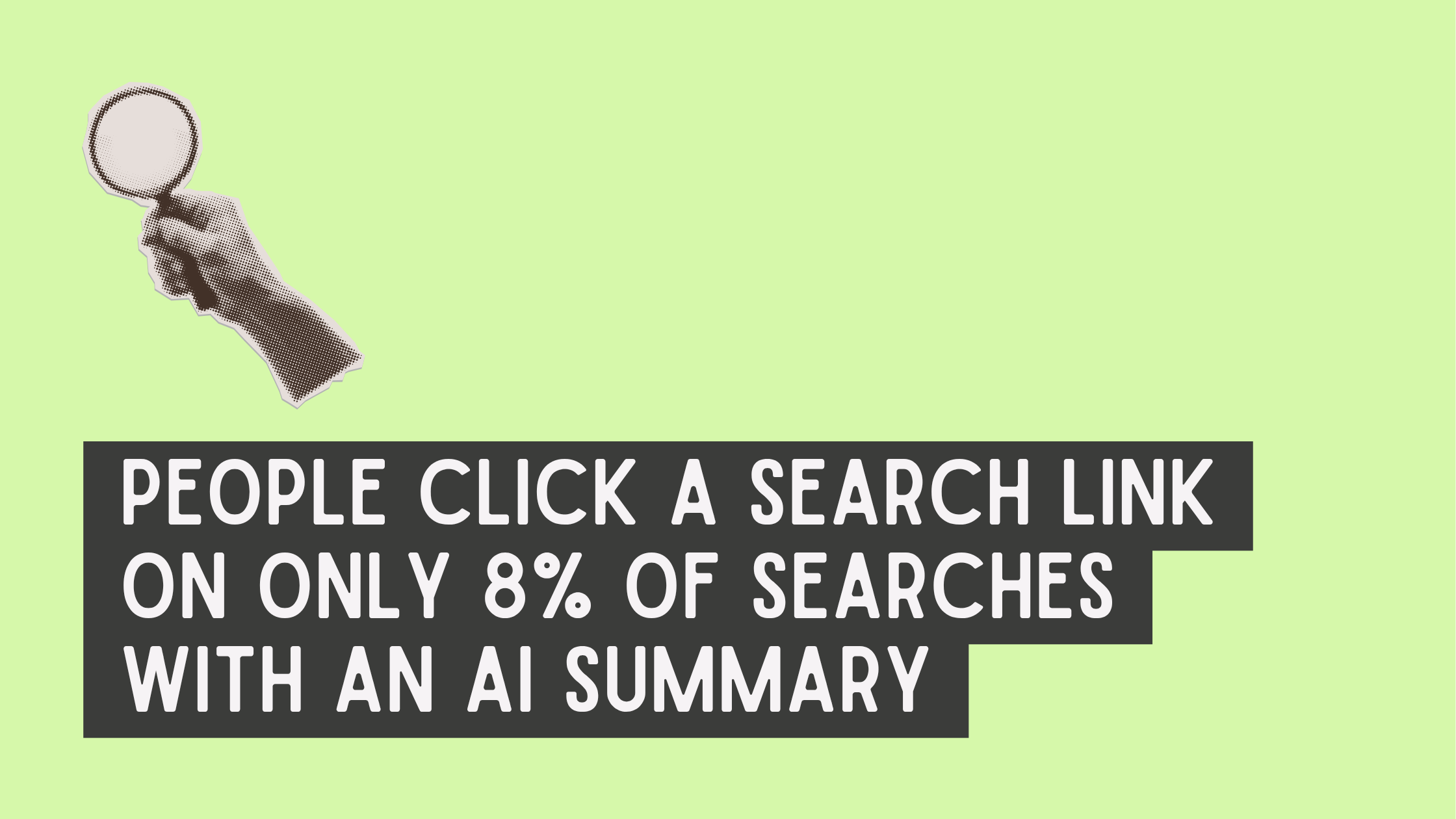
AI search sends fewer clicks but higher-intent ones, so the goal shifts from ranking to being the answer that gets cited. Pew Research Center tracked real browsing behaviour and found:
When an AI summary sits at the top of the results, people click a traditional link on just 8% of searches, versus 15% when there's no summary. Click a link inside the summary? About 1% of the time. The answer arrives, and the session often ends right there.
For product-led content, that's less grim than it looks, for two reasons:
The clicks that survive are hotter. Someone who reads an AI summary and still clicks through is further along and closer to acting. Fewer visitors, higher intent – which suits pages tied tightly to your product (integration pages, comparisons, "how to do X with [product]").
Being cited is the new ranking. Those same Pew findings show 88% of AI summaries cite three or more sources. To be one of them, your content has to be clear, specific and genuinely the best answer to a real question.
How do you make content an AI is likely to cite?
To be the source an AI answer pulls from:
Lead with the answer, then explain. Put the definitive line first.
Keep each section self-contained, so it still makes sense lifted out of the page.
Be specific and cite real sources. Models favour verifiable, sourced claims over vague ones.
Use clear, question-shaped headings that match how people actually ask.
When the click is scarcer, the page it lands on has to do more, so the acquisition content and the activation copy stop being separate projects and start being one.
How do you weave the product in without sounding salesy?
You earn the mention. Teach the topic so genuinely well that reaching for your product feels like the obvious next move, not an ad break. The line between product-led content and a dressed-up sales page comes down to four habits:
Teach it properly first
If someone could screenshot your article, delete every product mention, and still walk away helped, you've earned the right to show the product. If they couldn't, you've written a brochure.
Introduce the product where it's the obvious tool
Not in the intro. Not in a CTA bolted onto the end. At the exact step where a knowledgeable friend would lean over and say "here, just use this."
Show it doing the specific job, not the whole feature list
One screenshot of the product solving the problem in this paragraph beats a tour of everything it can do. Nobody reads the tour.
Cut it where it doesn't genuinely help
Some sections are better with no product in them at all. Forcing it in is exactly how readers smell the sell. Leaving them clean makes the moments where the product does fit land harder.
Content loops: how product-led content compounds
A growth loop is a system where the output of one user's activity becomes the input that brings in the next user, so growth compounds instead of leaking. A funnel is something you refill from the top forever, a loop feeds itself.
A lot of the best loops are made of content. Someone makes something in your product and shares it. Whoever receives it sees the product, signs up, makes their own thing, shares it. Round and round:
Loom – every video you send is a tiny ad for Loom, watermark and all.
Canva and Figma – designs and files get shared, forked and published, and each one shows off the tool.
Calendly – every booking link you send is the product, subtly doing outreach for you.
Typeform and Notion – the form, the public page, the shared template: all product, all travelling to new people.
The copy that makes a loop spin is tiny, and wildly under-valued. The eight words on the share button. The default line in the invite. The "Made with [product]" you either claim or waste.
So before you pour another month into blog posts, ask the question: does your product make something people already send to other people? If it does, the highest-leverage content you own might be the label on a button.
How do you measure PLG content?
You measure product-led content by whether users moved (activation, adoption and revenue) not by traffic:
Activation rate: the share of signups who reach first value. In-product copy owns this.
Time to value: how fast they get there. Clear onboarding shortens it.
Trial-to-paid / free-to-paid: the money metric for the whole motion.
Feature adoption: whether education content and nudges get people using more.
Product-qualified leads (PQLs): users whose behaviour in the product signals they're ready to buy.
Expansion / net revenue retention, fed by retention and upgrade copy.
Before you write in-product or onboarding copy, agree the one metric it's meant to move, and make sure someone's measuring it.
"This rewrite is meant to lift day-one activation from X to Y" turns copy from a cost into an investment with a number on it.
(My deeper dive on picking the right activation milestone is here.)
The takeaway
Content for product-led growth is the words doing the work the product needs done: pulling the right person in, walking them to their first win, keeping them there, and making the upgrade feel obvious.
So write to the stage, in the customer's language, measured against a milestone. And you’ll have already done a whole lot.
Let's make your product's words work harder
💡 If your product's brilliant but people stall before they feel it, the words are usually the problem. I help SaaS teams build powerful messaging and verbal brand strategy.
FAQ
What is product-led content?
Product-led content is content with your product woven into it, solving the exact problem the content covers, so the reader sees it working in context. Unlike a sales page, it teaches something real; the product is shown as the natural tool for the job, not a bolted-on pitch.
What are examples of product-led content?
Examples include Ahrefs' blog (every post shows the tool doing the job), Zapier's integration pages, Canva's template galleries, free tools like calculators and generators, and in-product onboarding copy. The common thread: the content shows or lets you use the product, not just read about it.
What is a product-qualified lead (PQL)?
A product-qualified lead is a user whose behaviour inside the product, not a form-fill or a content download; signals they're ready to buy. PQLs replace the marketing-qualified lead (MQL) in product-led growth, because how someone uses a product is a stronger buying signal than what they downloaded.
Is content marketing still worth it for PLG now that AI search exists?
Yes, but the target shifts from clicks to being the cited, useful answer. With fewer people clicking through from AI summaries, the content that wins is specific, product-tied and genuinely the best response to a real question, and the page it lands on has to convert the fewer, higher-intent visitors who do arrive.
What's the difference between product-led growth and content-led growth?
Product-led growth uses the product as the main engine for acquiring, converting and keeping customers. Content-led growth uses compounding content (usually SEO) as that engine. In practice they overlap: product-led companies use content to feed the product, and content is where a lot of the product-led journey actually happens.
Does product-led content work for developer tools?
Especially well. For developer products, the documentation is the marketing, it's how people discover, evaluate and adopt the tool, often with no sales team involved. The quickstart that gets someone to a working result fast is frequently the highest-value piece of content in the whole library.