How to Hire a Copywriter for Your Startup's Brand Voice
Your startup already has a brand voice.
It's in the way your founder pitches on a sales call, in the throwaway line in a Slack update that makes the whole team laugh. Or in the spontaneous answer to a customer's awkward question.
Then someone else writes the homepage, and it comes out sounding like every other startup on the internet.
That's usually the moment founders start looking for a copywriter to do the brand voice.
But a good brand voice copywriter won't invent a shiny new personality for you. They'll find the one you already have, and turn it into something your whole team (and your AI tools) can use.
I've run over 50 messaging workshops with SaaS teams, from early-stage startups to scale-ups.
This is exactly how I'd hire a copywriter for a startup's brand voice if I were sitting on your side of the table: when to do it, what you're buying, how to test for voice fit, and what it costs.
Let's do this ⬇️
How to hire a copywriter for your brand voice, in short
Short on time? Here's the whole process in seven steps:
Sort your messaging first. If you can't say what you do and why it matters, a voice won't save it.
Hire when a second person starts writing for your brand, not after ten people already have.
Look for a strategist who writes. Their portfolio should sound like their clients, not like them.
Run the play-it-back test. Ask them to describe your current voice before they write a single word.
Pay for a test on a real page, and judge the questions they ask as much as the draft.
Budget from the UK median of £440 a day (ProCopywriters, 2026) and expect a project fee.
Insist on a handover people and AI tools can apply: rules, word lists and before-and-after examples. Not three adjectives.
What does a brand voice copywriter do?
A brand voice copywriter defines how your company sounds, then writes with it.
They research your founders, customers and competitors, agree a direction with your team, and turn it into principles, word lists and real examples that anyone writing for your brand can follow.
The challenge is to make your voice transferable, so it survives the founder stepping back from the keyboard.
Some definitions, because they tend to get mixed up a lot:
Brand voice is your personality in words, it stays the same everywhere.
Tone is how much of that personality you turn up or down for the moment.
Messaging is what you say: your value proposition, pillars and proof. Voice is how you say it.
💡 I've written a whole post on the difference between brand voice and brand tone if you want to go deeper.
Do you need a copywriter for your brand voice, or your messaging first?
If you ask me, it’s messaging first, every time.
In my workshops, a request for "brand voice" is very often a messaging problem wearing a disguise. The copy feels flat, so the team assumes it needs more personality. But the bottom line is that nobody agrees on what the product does, for whom, and why it's better.
A voice can't fix a message that isn't there.
❌ We're a bold, human, disruptive platform reimagining how teams collaborate.
✅ Your sales team finds out a deal is at risk before the customer goes quiet.
The first one has plenty of "voice", but it says nothing. The second one is plain, specific, and sounds like it has a soul.
Signs your problem is messaging, not voice:
Your founder, sales team and website describe the product differently
You could swap your logo onto a competitor's homepage and nobody would notice
Your copy leans on adjectives ("powerful", "seamless", "intuitive") instead of outcomes
You've pivoted, raised, or changed your ideal customer in the last year
If that sounds familiar, start with a value proposition workshop and a messaging pyramid. Voice comes straight after.

When should a startup hire a copywriter for its brand voice?
Frankly, it's never too early. A brand voice copywriter can help you define your message before you've published a single word, and fine-tune it once you're growing and more people are writing for you.
What changes is the job they're doing:
Before launch: shaping your positioning, messaging and first words together, so your homepage, pitch deck and launch posts sound like you from day one (not like a template)
Early traction: capturing the founder's voice before it gets diluted, and writing it down for the first people who'll use it
Growing: fine-tuning a voice that's started to drift across product, sales, support, marketing and AI prompts
Rebranding or scaling: matching your words to a new look, a new market or a new category
In my experience, starting right is far easier than untangling years of inconsistent copy later. Every page you publish before the voice is clear is a page you'll probably rewrite.
The moments founders usually get in touch:
You're about to launch and nothing is public yet, so you get to start the way you mean to go on
Your first marketing hire or agency is about to start, and the voice only exists in the founder's head
Three or more people write customer-facing copy (product, sales, support, marketing) and they all sound different
You're about to rebrand, and the designers are delivering a new look with no words to match
You're scaling content with AI tools and everything is starting to sound suspiciously similar
You've raised or launched a new category, and the stakes on every page just went up
Brand voices are found, not invented
The startup voices people admire usually started with the founders. Innocent wasn't following a voice strategy when it launched in 1999.
As their head of creative put it: "There was no strategy or theory behind it 14 years ago, we were just trying to make each other laugh"
So the right copywriter works like an archaeologist before an architect. They dig out what's already distinctive about how you talk, then build the rules around it.
Why does brand voice matter for a startup?
Because for a startup, voice is a trust tool first and a personality tool second. And trust is what you're shortest on.
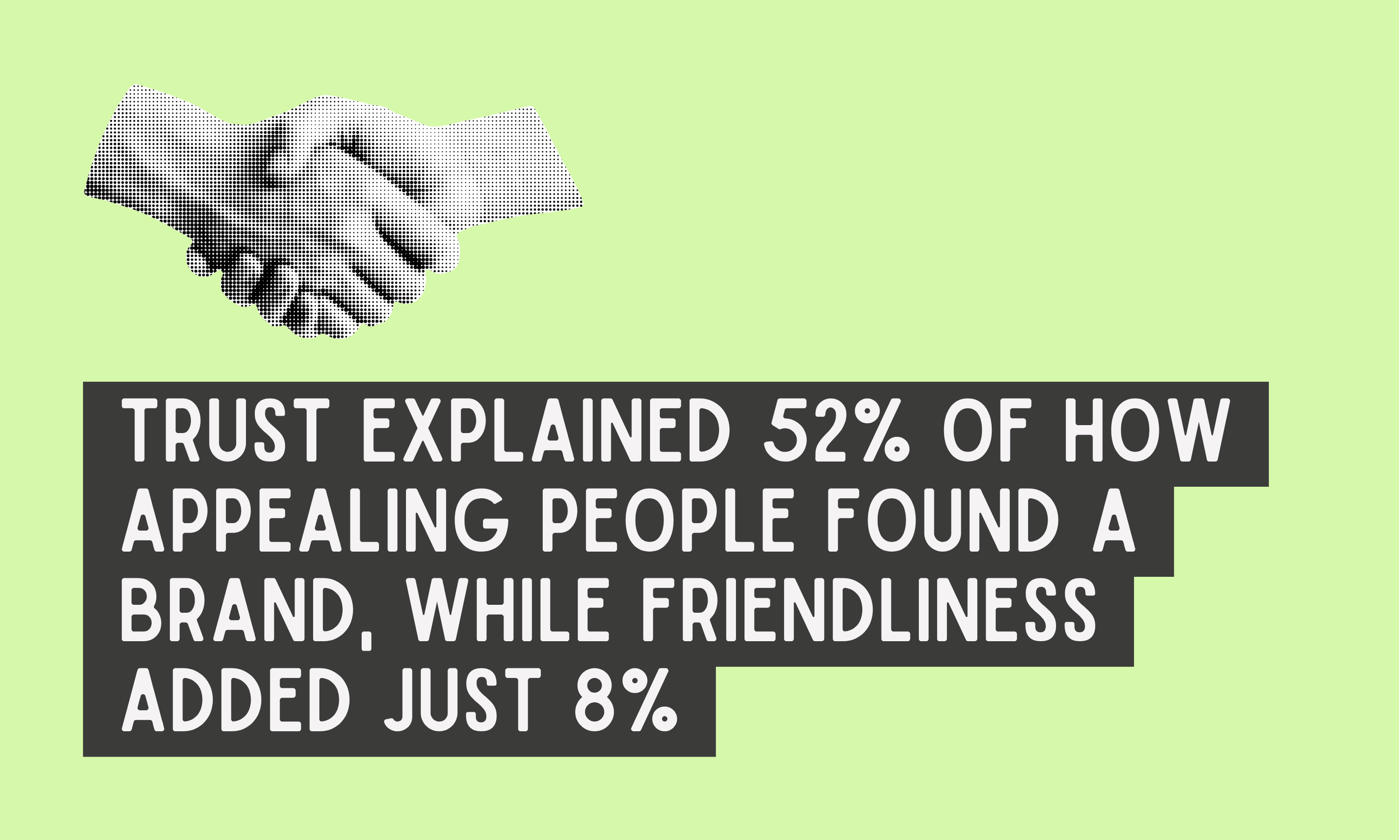
Trust is way more important than friendliness
When Kate Moran at Nielsen Norman Group tested the same websites in different tones with 100 people, casual, conversational and moderately enthusiastic tones performed best. But the finding I quote most is this one: trustworthiness explained 52% of how desirable people found a company, while friendliness added only another 8%.
Humour is where it gets interesting. In the car insurance test, the funny, irreverent version was rated friendlier but less trustworthy. Yep, your founder’s dry, witty humour can annoy the hell out of your users, so tread with caution.
So "let's be quirky" is not a voice strategy. If you're selling payroll software, fintech or anything with a compliance team, personality has to earn trust, not spend it.
"Human" doesn't mean emoji
The other myth I see a lot of: sounding human means being casual. Slang, exclamation marks, a sprinkle of 🚀.
Research says otherwise. A 2021 study in the Journal of Business Research reviewed 38 papers and tested brand messages on 137 people. Personalisation (addressing people directly, speaking as a real person, signing off with a name) did the most to make a brand sound human. Informal language like emoji and contractions did the least.
❌ Hey there! 👋 We're super excited to help you crush your goals!!
✅ Sam, you'll get a reply from me within a day. If it's urgent, call us.
Can AI write in your brand voice?
When Anil Doshi and Oliver Hauser gave writers AI-generated ideas, their stories were judged more creative. But the AI-assisted stories were also 10.7% more similar to each other. Better individually, but blander collectively.
And switching tools won't save you. A NeurIPS 2025 study that tested language models on 26,000 open-ended prompts found that different models produce "strikingly similar outputs".
Customers notice, too. In Klaviyo's survey of 8,000 consumers across eight countries, 32% said brands clearly using AI-generated content made them trust those brands less, against 7% who trusted them more.
AI makes it easy to write competent copy that sounds exactly like your competitors'. A distinct, unique, and well-documented voice is how you stop that happening.
What does brand voice work include?
When you hire a copywriter for your brand voice, you should be buying a process, not a PDF. Here's what a solid voice project looks like, and what I'd expect at each stage.
1. Discovery: listen before writing anything
Interviews with the founders, plus whoever talks to customers most (sales, success, support)
An audit of your existing copy: website, onboarding emails, sales decks, error messages, LinkedIn posts
A competitor language audit. Line up five competitors' homepages: if your headline could sit on theirs without anyone noticing, that's your starting point
2. Your customers' words
Reviews, sales-call recordings, support tickets, interview transcripts. The words your customers use to describe the problem are the raw material for your voice.
3. A workshop to agree direction
A working session with the people who'll own the voice. The goal is agreement, not a finished guide.
If you're curious what happens in these workshops, these are the exercises I use to find a brand's voice.
4. Principles written as tensions
Three or four voice principles, each with a line it won't cross. Tensions are much easier to write with than adjectives.
❌ Friendly, bold, human.
✅ Direct, but never cold. Confident, but never smug. Playful in marketing, never in a billing email.
5. Tone by channel
Your voice stays put, but the dial moves. Your voice stays the same, your tone evolves to adapt to the context.
For most startups, being able to adapt that dial matters most in three places: product copy, sales emails and anything involving money or bad news.
(Your error messages are where a voice gets puts through the wringer.)
6. Rules people (and AI tools) can follow
For every principle, write concrete rules. Here's what that looks like for an invented B2B fintech:
Principle: direct, never cold ✅"you'll get paid", "here's why" ❌"leverage", "solution", "seamless" ➡️Lead with the outcome. One idea per sentence
Principle: Confident, never smug ✅"we checked", "here's the proof" ❌"best-in-class", "revolutionary" ➡️ Every claim gets a number or an example
Principle: Warm in hard moments ✅"sorry", "here's what to do next" ❌"unfortunately", "please be advised" ➡️ Say what happened, then what to do. No jokes
Paste that into your AI tool's instructions and it has something to work with. Paste "friendly, bold, human" and it'll give you the same copy it gives everyone else.
7. Before-and-after rewrites
Real pages from your site, rewritten in the new voice, side by side with the old version. Super useful to help your team understand exactly how to write in your voice.
8. An owner and a habit
In my experience, a voice with no owner fades fast. Someone needs to review copy, onboard new writers and keep the examples fresh.
Slack, for example, assigned an editorial lead to run voice workshops for every new hire and hold regular review sessions with product marketing.
💡 I go deeper on this in how to create brand voice guidelines your team will actually use.
How do you test a copywriter for brand voice fit?
Being able to write is, in no uncertain terms, the easy part. What you’re testing when it comes to hiring a brand voice copywriter is whether they can hear you.
These are the five tests I'd run if I were hiring.

1. The play-it-back test
Send three pieces of your current copy: your homepage, a customer email, and something the founder wrote themselves. Ask the copywriter to describe your voice back to you in one paragraph.
✅ A good answer names specific choices: how long your sentences are, how you address the reader, words you lean on, words you avoid, where you're funny and where you're not.
❌ A weak answer gives you three adjectives. "Friendly, confident, approachable" describes every SaaS company on earth.
2. The portfolio range test
Read five of their samples back to back. Do they sound like three different companies? Good.
If every piece sounds like the copywriter, you'll end up sounding like them too.
3. The swap test
Ask them to rewrite one line from your homepage.
Then ask: could a competitor use this sentence? If the answer is yes, it's not your voice yet. The best voice writers apply this test to themselves without being asked.
⚠️ By the way, if you’re assessing which copywriter to hire, and asking for test tasks, pay for every task. Yes, even the tiny ones. Even the "just one paragraph" play-it-back. Unpaid tests put off the writers you want: experienced copywriters with full diaries will definitely turn down spec work.
4. The bad-news test
Ask for an error message, a price-rise email or a delayed-delivery note in your voice. Anyone can sound charming in a hero headline. Voice gets tested when the news is bad and the reader is annoyed.
5. A paid test on a real page
One page or one short email sequence, paid at their normal rate. Judge the questions they ask before they start as much as the draft they hand back.
What questions should you ask a copywriter before you hire them?
Here are the questions I'd ask, and what to listen for.
❓ How would you find our voice? ➡️Founder and customer interviews, your existing copy, sales calls, then a workshop
❓ What if our messaging isn't clear yet? ➡️"I’d fix what you say before how you say it"
❓ Can you show me work in different voices? ➡️Samples that sound nothing alike
❓ How does our voice change in product copy or bad news? ➡️Tone turns down; clarity always wins
❓ What will we have when you're finished? ➡️Principles, word lists, rules, before-and-after rewrites, a handover session
❓ How do you use AI, and can you set up our tools to use the voice? ➡️Clear on where AI helps and where they decide; writes rules an AI tool can follow
❓ Who signs off, and how many rounds of revisions are included? ➡️A named decision-maker and a set number of rounds
Red flags when hiring a brand voice copywriter
The proposal has no discovery or research stage
They promise a voice in a day, without speaking to a single customer
Their deliverable is a mood board and three adjectives
They price voice work per word (it rewards length, not thinking)
They'd apply personality to buttons, forms and error messages, where clarity has to come first
💡 Hiring for a B2B SaaS product specifically? My guide to hiring a B2B SaaS copywriter covers the wider vetting process.
How much does a brand voice copywriter cost?
In the UK, the median freelance copywriter day rate is £440, with rates ranging from about £300 to more than £1,800 a day, according to ProCopywriters' 2026 survey of 383 freelancers. The median has risen 10% in two years.
A few things to know before you ask for quotes:
Expect a project fee. It's the most common way copywriters price, and it means you know the cost upfront. Day rates tend to be used for workshops and exploratory work that's hard to scope.
Avoid per-word pricing for voice work. Most of the value is in the research and decisions, not the word count.
Agree the revision rounds in writing. Unclear revisions are the most common reason copy projects run over.
Specialists cost more. Regulatory know-how (think financial services or healthcare) and specialist sector knowledge both push fees up.
How I price
I charge per page, at approx. £300 for a page of copy,like a homepage for eg. That way costs are completely transparent, and you know exactly what you're paying for before we start.
Complex or heavily regulated industries can shift the rate slightly, but that's always agreed with you upfront, before the project kicks off.
For a fuller breakdown, see my post on the average copywriting day rate.
Should you hire a freelance copywriter, an agency or in-house?
For most startups, a freelance copywriter who does both the strategy and the writing is the sweet spot. You get senior thinking without an agency's overheads, and the same person who found your voice writes your first key pages in it.
Freelancer: best for defining the voice and writing the pages that matter most
Agency: makes sense when you need a large team rolling a voice out across many markets at once
In-house writer: best once you have enough copy to fill a full-time role, ideally after the voice is defined, so they have something to work to
I compare all three in more detail in freelance copywriter vs in-house vs agency.
How do you brief a copywriter on your brand voice?
The better the raw material, the better your voice. Before your copywriter starts, pull together:
Anything that already sounds like you: founder emails, podcast appearances, a LinkedIn post that did well, a pitch deck you're proud of
Recordings of the founder talking about the business. Spoken voice is often more "you" than anything you've written
Customer language: reviews, sales-call recordings, support tickets, survey answers
What you'd never say. Brands, phrases and habits you can't stand are just as useful as the ones you love
Access to people: half an hour each with sales, support and a couple of customers
One decision-maker, named upfront
And one timing tip: bring the copywriter in before the designer. Designing around placeholder copy almost always means redesigning later.
💡 My step-by-step guide to briefing on your brand voice walks you through what to include.
What should you have at the end of a brand voice project?
Use this as your checklist when comparing proposals:
✅ A short summary of your voice anyone can read in two minutes
✅ Three or four principles, each written as a tension ("direct, but never cold")
✅ How the tone shifts across product, sales, support and social
✅ Words and phrases you use, and ones you don't
✅ Sentence-level rules an AI tool can follow
✅ Before-and-after rewrites of your real pages
✅ A handover session with the people who'll write in the voice
✅ A named owner who keeps it alive
If you want to get a head start before you hire anyone, my brand voice worksheet walks you through 12 exercises.
Ready to find your voice?
If your startup sounds like everyone else in your space, or your voice only works when the founder writes it, I’d love to lend a hand.
I run verbal brand strategy projects for SaaS and growing startups: messaging, voice and the words that go on your site.
Book a chat with me and we'll work out whether you need a voice, a message, or both. 👀
Brand voice copywriter FAQs
Can a copywriter write in my brand voice?
A good brand voice copywriter studies how your founders talk, what your customers say and how your competitors sound, then writes to agreed principles. Give them real samples, recordings and customer language, and check their portfolio covers more than one voice.
What's the difference between brand voice and tone of voice?
Brand voice is your consistent personality in words. Tone is how you adjust that personality for the situation: warmer in a support reply, plainer in a billing email, livelier on social. Your voice shouldn't change from channel to channel. Your tone should.
What is a tone of voice copywriter?
A tone of voice copywriter is a copywriter who specialises in defining how a brand sounds, not just writing individual pages. They typically run discovery and workshops, write voice principles and guidelines, and train teams to use them. "Tone of voice copywriter" and "brand voice copywriter" usually mean the same job.
Do early-stage startups need brand voice guidelines?
Not on day one. While the founder writes everything, the voice lives in their head and that's fine. Write it down when a second person starts writing for the brand, and sort your messaging first. A short, example-led guide beats a 40-page brand book nobody opens.
Can AI write in my brand voice?
Partly. AI tools can follow a voice if you give them specific rules, word lists and real examples. Adjectives alone won't do it. And because different AI models tend to produce strikingly similar outputs, a human still needs to define the voice and edit what comes out.
Should I hire a copywriter or a designer first?
The copywriter. Your messaging and voice shape the layout, not the other way round. Designing around placeholder text usually means reworking pages once the real words arrive.