SEO vs GEO: What's the Difference?
Your best-performing page is losing a third of its clicks to a grey box of AI-generated text sitting above you.
Yep, Ahrefs found that when a Google AI Overview shows up, the top-ranking page gets a 34.5% lower average click-through rate.
People click a normal search result in just 8% of visits when an AI summary appears, versus 15% when it doesn't, and they click a link inside the summary a measly 1% of the time.
So optimising for AI search isn’t a fresh coat of paint on your SEO. It isn't. It's a different game with a different scoreboard, and it has a name: Generative Engine Optimization, or GEO.
So let's get the difference between SEO and GEO straight: what each one actually optimises for, what's genuinely changed, and exactly what to do about it. Backed by the research, not vibes.
SEO vs GEO: the short answer
SEO (Search Engine Optimization) gets your page to rank as a clickable link in a list of results.
GEO (Generative Engine Optimization) gets your content cited, quoted or recommended inside the answer an AI writes: in ChatGPT, Google's AI Overviews, Perplexity, Gemini or Copilot.
SEO wins you a position and a click. GEO wins you a mention, whether or not anyone clicks.
TLDR:
SEO optimises a page to rank. GEO optimises your content to be cited in a generated answer
SEO's currency is the click. GEO's currency is the mention
SEO rewards keywords, links and technical health. GEO rewards citations, statistics, quotes and authority; and keyword stuffing does nearly nothing for it
You don't pick one. Solid fundamentals feed both, but the way you write and structure content has to change.
What is SEO?
You likely know this one, so I'll keep it quick. SEO is the practice of getting a page to rank in a traditional search engine (Google, Bing, etc) so people click through to your site.
It rests on three pillars:
Technical: can search engines crawl, render and index your pages? (Speed, structured data, clean architecture – the stuff in myultimate blog SEO checklist.)
On-page: does the content match what the searcher actually wants, with the right headings, internal links and depth?
Off-page: do other credible sites vouch for you, mostly throughlinks?
Win, and you climb the ranked list. The higher you sit, the more clicks you earn. The whole model assumes a human scans a list and chooses where to go.
What is GEO?
GEO is optimising your content so it turns up inside AI-generated answers: as a source that gets cited, a fact that gets quoted, or a brand that gets recommended.
In November 2023,a Princeton-led team published "GEO: Generative Engine Optimization" and coined the phrase. They defined a "generative engine" as a system that answers you by synthesising information from multiple sources and summarising it with a large language model, which is what ChatGPT, Perplexity and AI Overviews do.
They also built GEO-bench, a benchmark of thousands of real queries across different domains, to test what works.
So the right optimisation methods can boost a source's visibility in generative responses byup to 40%. Which methods? I'll get to the specifics below, because they might not be the ones you're used to. ⬇️
SEO vs GEO: the key differences
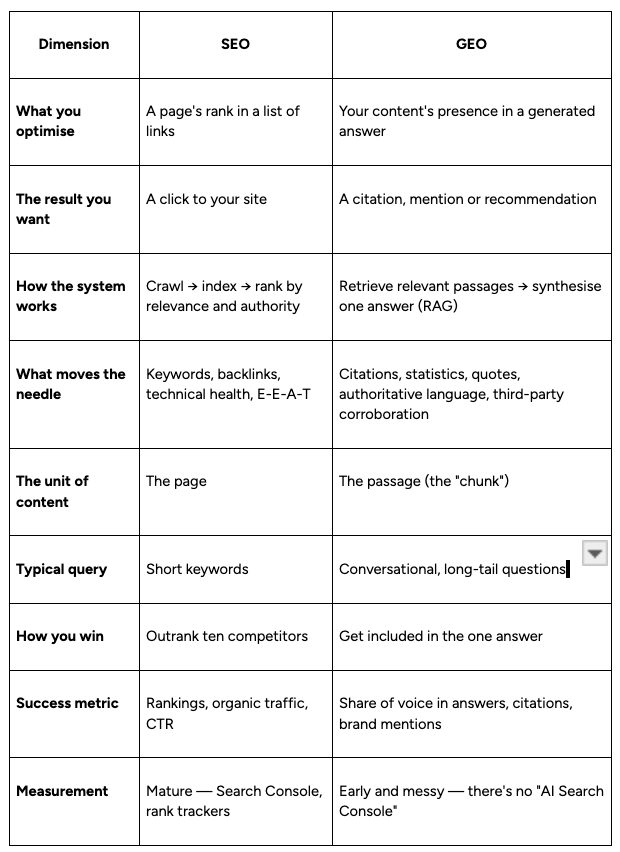
The output changed
SEO competes for one of ten slots. Ten pages can each earn a click.
But GEO competes to be part of a single synthesised answer. You're either in it or you're invisible, there's no "page two" to console you.
The mechanism changed
Search engines rank whole pages. Generative engines retrieve passages and stitch them into an answer (the technical term is retrieval-augmented generation).
So a single, cleanly-written paragraph can get pulled into an answer even if the rest of the page isn't your strongest work – and a page that ranks brilliantly can get skipped if its key facts are buried in waffle.
The scoreboard changed
SEO success is a click. GEO success is often zero-click: you influenced the buyer, shaped the answer, got named as the recommendation, and nobody visited your site to do it. That's a different kind of win, and it needs a different kind of measurement.
Why does GEO matter?
When an AI Overview appears, the top organic result loses roughly a third of its clicks (34.5%).So rank well and wait for the traffic is no longer the plan it was a couple years ago.
What that means strategically:
Informational content becomes a visibility play. A how-to article might never earn the click it used to, but if the AI quotes you as the source, you've still won mindshare and authority. Judge it on citations and brand lift, not just sessions.
Being the named recommendation is the new position one. When someone asks an AI "best onboarding tool for fintech" and it names you, that carries an implied endorsement a blue link never had. That's a prize worth chasing.
Attribution gets harder. You can't last-click your way to proving GEO worked. Expect to lean on branded search growth, direct traffic and "how did you hear about us?" more than you'd like.
The traffic that does arrive can be worth more. Across 94 ecommerce sites in 2025, ChatGPT referral traffic converted at 1.81% versus 1.39% for non-branded organic – 31% higher. Someone who arrives via an AI answer has usually been pre-qualified by the conversation that sent them.
Where SEO and GEO overlap
A lot of what is a solid SEO foundation actually carries straight over:
Genuinely useful, accurate content, because an AI won't cite a source that appears thin or wrong.
Technical accessibility is non-negotiable both ways. If a bot can't fetch and read your page, it can't rank or cite it.
Structured data and clean headings help machines parse you, full stop.
E-E-A-T (experience, expertise, authoritativeness, trust) maps well onto what generative engines reward.
A clear brand entity (consistently described, easy to place) helps Google's Knowledge Graph and an LLM's sense of who you are.
GEO isn't the opposite of SEO. It's the next layer on top, and you build it on the same foundation. The daft move would be to chase AI visibility while letting your technical SEO rot. Do both.
How to optimise for GEO (without wrecking your SEO)
The Princeton team tested specific tactics against GEO-bench and measured which ones actually lifted visibility ⬇️
What generative engines reward ✅
Adding citations to credible sources. Content that points to its evidence gets pulled into answers more often.
Adding relevant statistics. Swapping vague qualitative claims for quantitative ones was one of the top-performing methods.
Adding quotations from credible experts. Quoting authority lends your content authority.
Writing with authority. A more confident, persuasive, source-backed style measurably outperformed a wishy-washy one.
Together,those methods lifted visibility in generative responses by up to 40%. Notice what they have in common: they all make your content more credible and more quotable. That's the whole game.
What it ignores ❌
Keyword stuffing. The most old-school SEO trick – cramming in query keywords – gave "little to no improvement" in generative responses. The engines aren't counting your keywords, they're assessing your credibility.
💡 One genuinely encouraging finding for smaller B2B sites:the paper found that lower-ranked websites benefit significantly more from GEO than the giants do. Generative engines don't defer to domain authority the way traditional search does, so being brilliantly quotable can leapfrog you past sites you'd never outrank on links alone.
Here's what follows from how these engines work:
Answer the question first. Lead with the direct answer, then support it. Front-loaded, self-contained paragraphs are what retrieval systems grab.
Write in chunks that survive on their own. Because engines pull passages, every key paragraph should make sense lifted out of context. No "as I mentioned above."
Structure for extraction. Clear H2s and H3s, comparison tables, tight FAQ sections. The more parse-able you are, the more quotable you are. (You're reading a post built this way on purpose.)
Chase mentions, not just links. When Ahrefs studied 75,000 brands, branded web mentions correlated with AI Overview visibility far more strongly than backlinks and brands with the most mentions earned up to 10x more AI mentions. For years we chased links. For GEO, chase being talked about, and note that unlinked mentions count. Digital PR, podcasts, being named in roundups: that's GEO fuel now.
Show up where the models trust. Generative engines lean on a handful of sources disproportionately. Reddit is one:Google signed a content-licensing deal with Reddit reportedly worth about $60 million a year, which is part of why it surfaces so often in answers. A credible, helpful presence in the communities your buyers actually use can do more for your AI visibility than another guest post nobody reads.
Mind your AI crawlers. You can allow or block AI bots separately from Googlebot: OpenAI's GPTBot, Anthropic's ClaudeBot, PerplexityBot and the rest. But Google's documentation states that Google-Extended (the token that controls whether your content trains Gemini) "does not impact a site's inclusion in Google Search". Translation: blocking Google-Extended will not keep you out of AI Overviews, because Overviews live inside Search. If you want out of Overviews, there's no clean lever that keeps your rankings intact.
Don't sink a day into llms.txt. It's the fashionable idea that a Markdown file at /llms.txt will hand-guide AI to your best content.Google's John Mueller has said LLM systems can't use files like llms.txt to decide which sites to surface, and pointed straight back to ordinary HTML pages and internal links as the foundation for discovery. Until a major engine actually commits to reading it, that hour is better spent on clean HTML and a sensible internal-linking structure.
And no, none of this means "publish AI slop at scale." Quite the opposite, the tactics that win are the ones that make content more rigorous and human.
(If you're worried about the AI-detection issue, I've written separately on whether Google can detect AI content.)
The takeaway
SEO gets you ranked. GEO gets you quoted.
One earns a click; the other earns a mention – and increasingly, the mention is where the buyer's mind is made up.
The good news is you're not starting over: the same rigorous, credible, well-structured content that's always won at SEO is exactly what generative engines reach for.
You just have to write it to be extracted, not only ranked. Lead with the answer, show your evidence, and make every paragraph worth quoting.
💡 Want your content to be what AI actually cites when your buyers go looking? Let’s chat
Frequently asked questions
Is GEO replacing SEO?
No. GEO is an added layer, not a replacement; most of your technical and content fundamentals feed both. What's changing is the scoreboard: a growing share of success is now a citation or recommendation inside an AI answer rather than a click to your site. Do your SEO and optimise for generative engines.
What's the difference between GEO and AEO?
Not much, in practice. AEO (Answer Engine Optimization) is the slightly older term, rooted in featured snippets and voice assistants. GEO specifically covers generative, LLM-written answers that synthesise multiple sources. Most people now use them interchangeably; GEO is the term that's stuck.
Should I block or allow AI crawlers like GPTBot?
It depends on your goal. If you want to be cited and recommended in AI answers, you generally want to allow the crawlers that power live retrieval. If you specifically object to your content training models, you can block tokens like GPTBot or Google-Extended, but remember Google-Extended doesn't affect your inclusion in Google Search or its AI Overviews, so blocking it won't remove you from Overviews.
Does traffic from AI search actually convert?
Yes, often better than you'd expect, though there isn't much of it yet.A 12-month GA4 analysis of 94 ecommerce sites reported by Search Engine Land found ChatGPT referral traffic converted at 1.81% versus 1.39% for non-branded organic – 31% higher. Visitors arriving from an AI answer tend to be further along in their decision. The caveat: total volume is still small and its growth is slowing, so think of it as high-intent upside, not a channel that replaces search.
Is it worth setting up an llms.txt file?
Not yet, on the current evidence. Google's John Mueller has said LLM systems can't use llms.txt to decide which sites to surface, and pointed back to standard HTML and internal links as the basis for discovery. No major engine has committed to using it. It's harmless to add, but don't mistake it for a GEO strategy, your effort is better spent on clean, crawlable HTML.
Can you actually measure GEO?
Only roughly, for now. There's no equivalent of Search Console for AI answers, so you're stitching together signals: branded-search growth, direct traffic, mentions in AI tools, and a crop of AI-visibility trackers that prompt the engines on a schedule and log who gets named. Treat every number as directional and watch the trend, not the decimal.
Is GEO worth it for a small B2B SaaS site?
Arguably more so than for a big one.GEO research found that lower-ranked sites gain significantly more visibility from these tactics than established players do, because generative engines don't lean on domain authority the way Google's rankings do. If you've been stuck behind bigger competitors on the SERP, being genuinely quotable is your way round them.